How to Choose Potato Chips Made From Nearby, Fresh-Grown Potatoes
How to Choose Potato Chips Made From Nearby, Fresh-Grown Potatoes
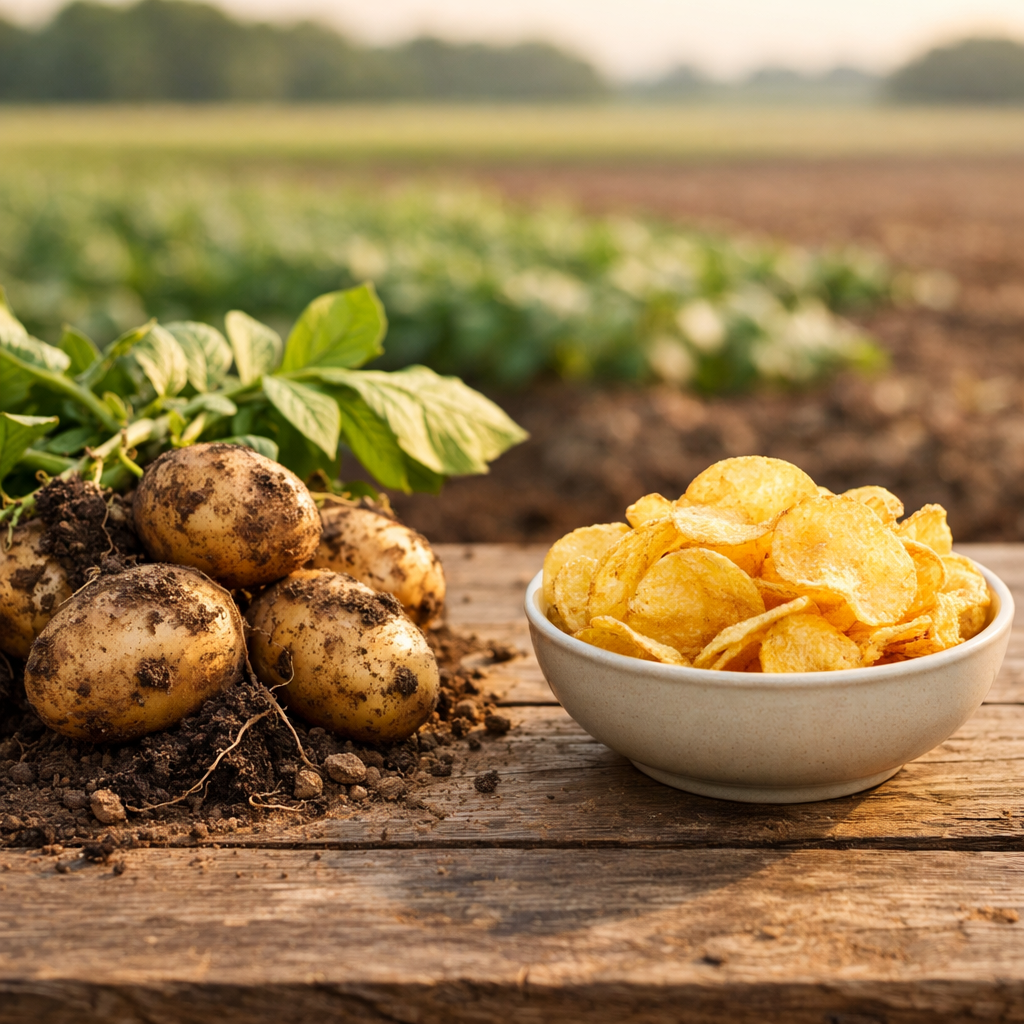
Finding chips truly made from nearby, fresh-grown potatoes comes down to origin you can verify, recent packing, and simple, potato-forward recipes. Start by scanning the bag for a named farm or region, then check for a recent “packed on” date and minimal ingredients. Favor brands that name chipping varieties and describe careful handling from harvest to fry; these cues correlate with golden color, balanced crunch, and reliable freshness. Consumer preference hinges on color and uniform appearance, so use your eyes first—and let the nutrition panel guide portions. Below, Snack Comparison Hub shows how to evaluate local potato chip brands with fast, objective checks you can do at the shelf.
Define local and set your selection criteria
“Local potato chips are products made from potatoes grown within a short supply chain—ideally the same state or nearby region—where growers and processors disclose the farm or region and packing timelines, enabling faster harvest-to-pack that preserves freshness, color, and crisp texture.”
Set selection criteria that predict flavor, texture, and transparency—while making it easy to compare local potato chip brands:
- Verifiable potato origin: A named farm, state, or specific growing region on the package (or via QR) confirms nearby potatoes and short hauls.
- High potato percentage: More real potato in the chip typically improves crunch and authentic flavor while limiting additives.
- Recent pack date: A short harvest-to-pack window supports crispness and aroma.
- Named chipping varieties: Varieties bred for chips help color uniformity and consistent oil uptake.
- Minimal additives: Simple formulas align with potato-first, local-fresh positioning.
- Documented handling: Storage above 4°C and controlled sugars mitigate darkening.
- Acrylamide mitigation and sensory consistency: Look for blanching and crispness testing; color and appearance are top decision drivers in chips, per peer-reviewed sensory research on potato chips.
Snack Comparison Hub applies these criteria consistently so you can compare brands side by side without guesswork.
Verify potato origin on the package
To confirm local sourcing fast, read the front and back panels for farm names, state or regional claims, and QR codes that link to provenance pages. Processors typically sort and wash tubers on arrival before slicing, and many U.S. plants draw from region-specific supply chains such as Washington farms, as profiled in this WAgrown profile of Washington chip processing. Industry stories from Washington note that roughly 90% of U.S. potato chips are made from Washington-grown potatoes—underscoring how near-source frying is feasible when farms and plants are co-located.
Use this simple verification list:
- Farm or growing region clearly named
- Scannable QR provenance with grower/lot info
- Retailer “local” or origin badge tied to a state/region
Snack Comparison Hub favors brands that provide farm- or lot-level provenance you can verify quickly.
Check ingredients and potato percentage
Chips with a higher share of real potato tend to deliver better texture and crunch and rely less on additives or fillers; both effects are emphasized in this quality factors guide. For classic salted chips, expect a short ingredient order: potatoes, oil, salt. If you see added powders or starches high on the list, the formula may be moving away from a potato-first profile.
Potato percentage refers to the proportion of real potato in the finished chip. A higher potato share typically strengthens authentic potato flavor, reduces dependence on flavorings or bulking agents, and keeps the label cleaner—an ideal fit for nearby potatoes and fresh-positioned chips, according to the same quality factors guidance. Snack Comparison Hub standardizes ingredient counts and notes when formulas stay potato-first.
Confirm pack date and freshness window
Prioritize recent “packed on” dates over distant “best by” windows. Faster harvest-to-pack helps lock in texture and aroma, a common practice in regional plants highlighted in the Washington processing profile. Many processors also run pilot fry tests to validate color and oil pick-up before scaling—often mentioned on brand pages as a quality step tied to timing.
Use this quick decoder:
| Label on bag | Why it matters | How to use it |
|---|---|---|
| Packed on | Most precise signal of recency | Choose the newest packed-on date |
| Best by | Shelf-life proxy set by the brand | If only this is shown, pick the farthest date out within a typical 6–10 week window for classic-fried chips |
| Plant code | Identifies processing facility and sometimes line | Match codes on the brand’s site to confirm regional packing |
Aim for bags within a 6–10 week freshness sweet spot for standard fried chips. Snack Comparison Hub calls out recency signals when brands disclose them.
Look for potato variety and handling details
Named chipping varieties are bred to fry evenly and stay golden. Common options include Lady Rosetta, Lady Claire, Saturna, Hermes, Verdi, as well as Agria, Atlantic, Ranger Russet, Premiere, and Endeavour, as detailed in this overview of chip-suitable potato varieties. The specs that matter:
- High dry matter (21–25%) for crisp texture
- Low reducing sugars (<0.3–0.5%) and low asparagine to limit darkening
- Round, smooth tubers for uniform slices and fewer defects
Note: Keeping harvested potatoes above 4°C until processing helps control sugar accumulation and acrylamide precursors, according to an acrylamide mitigation study. Snack Comparison Hub highlights named varieties and handling disclosures as signals of process control and consistency.
Review processing and safety practices
Quality-focused brands often share process cues in their materials. Look for blanching, thin slicing around 1 mm, moderate fry profiles (e.g., ~160°C for ~3 minutes), and pre-soaks such as 0.5% sodium chloride prior to blanching—methods shown to reduce acrylamide formation in the acrylamide mitigation study. For context, the EU benchmark level for chips is 750 µg/kg.
Acrylamide is a heat-formed compound created when reducing sugars and the amino acid asparagine react during high-temperature frying or baking. In potato chips, managing sugar levels, slice thickness, blanching, and fry temperature can markedly cut levels without sacrificing crispness.
Objective crispness testing (for example, three-point bend or break tests) helps brands fine-tune slice thickness, cook time, and packaging to deliver consistent crunch—clear signals of rigorous QA, as described in objective crispness testing methods. Snack Comparison Hub recognizes brands that communicate validated crispness testing and acrylamide-mitigation steps.
Use quick sensory checks before buying
Choose bags showing uniformly golden chips with minimal dark spots; color and appearance are primary decision factors, and color uniformity strongly influences perceived quality, based on sensory research. Try a four-step micro-check:
- Color: Golden-yellow typical of 150–190°C, 3–5 minute fries
- Structural integrity: Few broken shards
- Aroma on opening: Clean potato, no stale oil
- Texture: Crisp snap without excess brittleness
In tests, higher sensory scores correlated with better color uniformity (ΔE r=0.73) and less brittleness (fracturability r=−0.75). These are the same cues Snack Comparison Hub scores in taste-and-texture checks.
Validate sourcing transparency
Corroborate “local” claims with traceability. Scan QR codes, read farm stories, and look for short supply-chain documentation listing grower, region, and pack facility—the same signals highlighted in the Washington processing profile. Use this quick flow:
- Find the farm or region on the pack
- Cross-check the brand site for variety and handling notes
- Confirm a recent pack date
- Look for QA mentions such as pilot fries and break tests
Processors routinely pilot-fry to monitor color and sugar darkening before scaling; brands that share these steps earn trust. Snack Comparison Hub aggregates these disclosures so you can confirm them quickly.
Compare nutrition and portion control
Weight Watchers (WW) Points estimate overall food impact using calories, saturated fat, sugar, and protein in a single number to support quick, weight-management-friendly comparisons.
Because chips often contain 35–45% oil by weight (wet basis), as shown in a chip oil content analysis, portion-controlled single-serve bags can help moderate intake. Use this template to compare 1-oz (28 g) servings of nearby chips:
| Brand (example) | Calories | Total fat (g) | Sat fat (g) | Sodium (mg) | Est. WW Points | Oil type | Ingredient count | Single-serve under 100 cal? |
|---|---|---|---|---|---|---|---|---|
| Local Brand (illustrative) | 150 | 10 | 1 | 170 | 5 | Sunflower | 3 | No |
Tip: Standardize to 1 oz across brands; note oil type, sodium, and availability of under-100-calorie packs when possible. Snack Comparison Hub panels make 1-oz comparisons and WW estimates straightforward.
Where to find locally sourced chips
- Regional grocery chains that tag “local” products and highlight state-grown programs
- Farm stands, food co-ops, and CSA partners that stock nearby processors
- Direct-from-producer online shops with pack-date disclosure and farm profiles
If in doubt, ask which regional processing plant supplies the store. Modern facilities can run 25–30 semi loads per day when farms and fryers operate in the same region, indicating strong local capacity. Use quick locators: state “Grown In” seals, plant codes traceable on brand sites, and recent pack dates. On Snack Comparison Hub, we point to brand provenance pages and plant-code resources when available.
Snack Comparison Hub approach to evaluating local potato chips
At Snack Comparison Hub, we score chips on five pillars: verifiable origin (farm/region), chipping variety disclosure, handling and QA transparency (e.g., storage above 4°C, pilot fries, bend/break tests), clean ingredients, and taste/texture aligned with research-backed color uniformity and crispness correlations. Our nutrition-first comparison standardizes 1-oz (28 g) panels for calories, fat, and sodium; contextualizes oil percentage (chips ≈35–45% oil); estimates WW Points; and flags single-serve, under-100-calorie options where available. Qualitative checks focus on uniformly golden chips, minimal dark spots, and avoiding excess brittleness—attributes shown to track with higher sensory scores. Learn more about our methodology at Snack Comparison Hub.
Frequently asked questions
How can I tell if chips actually use local potatoes?
Look for a named farm or region on the bag, a scannable QR provenance page, and a recent pack date. Snack Comparison Hub’s quick checks highlight these signals.
What packaging dates should I prioritize for the freshest chips?
Choose the most recent “packed on” date. If only “best by” is listed, pick the farthest date out within a 6–10 week window for classic-fried chips; Snack Comparison Hub notes these details when disclosed.
Do kettle-cooked chips indicate fresher or more local potatoes?
Not necessarily; kettle-cooked is a frying style. Use Snack Comparison Hub’s origin and date checks to confirm locality.
Are fewer ingredients a reliable sign of higher potato content?
Often yes; potatoes, oil, salt usually signals a higher potato share. Snack Comparison Hub standardizes ingredient lists so you can compare quickly.
How do nearby-sourced chips typically compare on sodium, fat, and WW Points?
Local sourcing doesn’t guarantee lower sodium or fat. Snack Comparison Hub compares per 1-oz (28 g) serving and estimates WW Points to help with portions.