How to Find the Most Reviewed Chip Flavors Online, Reliably
How to Find the Most Reviewed Chip Flavors Online, Reliably
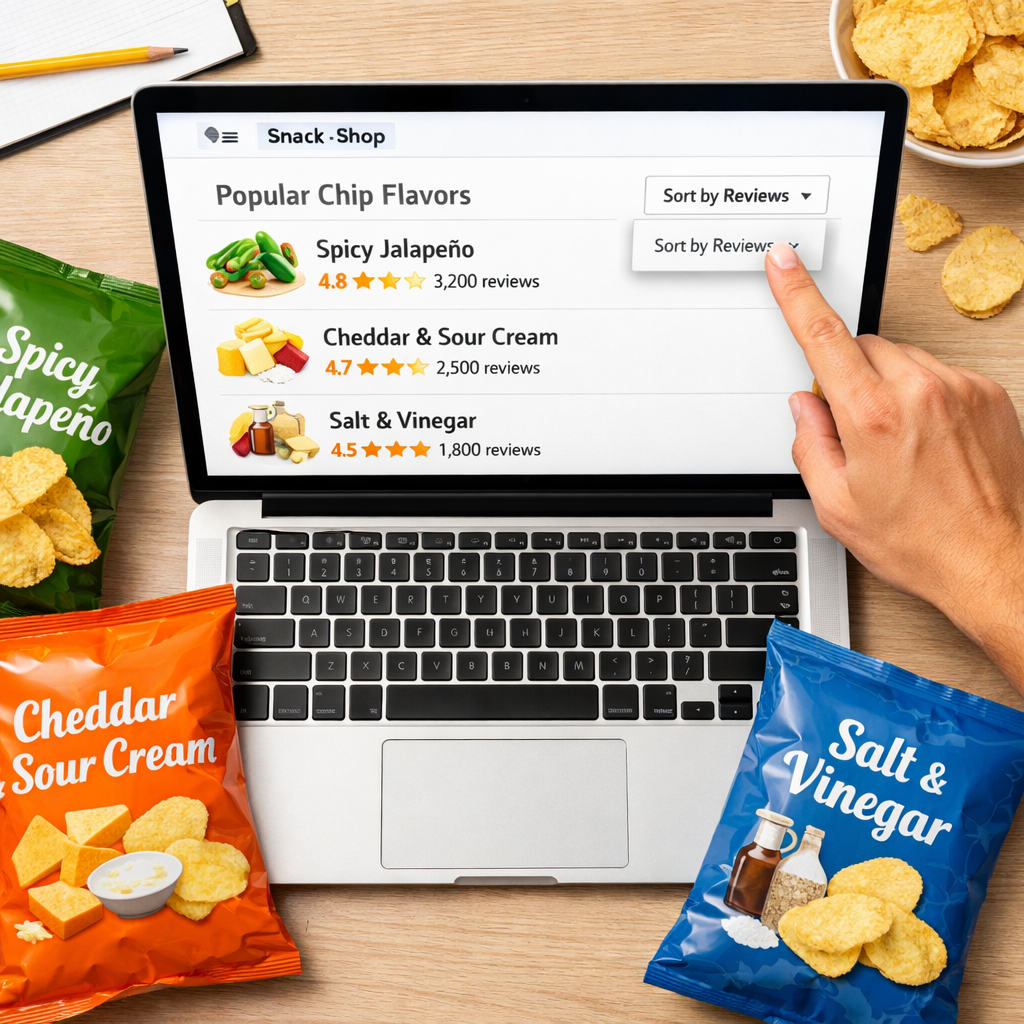
Finding the most reviewed chip flavors online is simple in spirit—count reviews—but tricky in practice. Listings get syndicated, flavors hide inside variants, and older, unverified reviews can overwhelm what shoppers actually think now. Here’s the reliable way: define a clear scope, aggregate reviews across retailers and editorial sites, de-duplicate by flavor SKU, and weight by recency, verification, and source trust. When you do this, the usual suspects rise: Sea Salt & Vinegar, BBQ, Sour Cream & Onion, Jalapeño, and Honey Dijon—flavors that also show up in expert tastings where Sea Salt & Vinegar is praised for a perfect salt-sour balance and Honey Dijon reads as Dijon-dipped chicken finger good, according to Epicurious’ kettle-chip panel. Use the method below to reproduce a ranking you can defend and update. This is the approach we use at Snack Comparison Hub to keep flavor rankings current and comparable.
Define scope and criteria
Start by narrowing the playing field so ranks are comparable and reproducible.
- Geography and categories: Choose a primary market (e.g., U.S.) and label categories clearly: potato chips (classic and kettle-cooked). You can run tortilla or puff categories in parallel, but keep them segmented so texture and usage don’t skew comparisons.
- Time window: A rolling 12–18 months balances recency and stability—enough reviews to smooth noise without memorializing outdated tastes.
- Working definition: “Most reviewed” means the highest weighted count of unique, de-duplicated reviews attached to a specific flavor SKU or clearly flavor-mapped listing over a defined timeframe.
- Measure both review volume and quality signals: verified purchases, recent reviews, and cross-site coverage.
Inclusion and exclusion rules (recommended)
| Rule | Include/Exclude | Notes |
|---|---|---|
| Geography | Include selected market (e.g., U.S.) | Keep retailer mix consistent with market |
| Chip types | Include potato chips (classic, kettle) | Segment other categories separately |
| Time window | Include last 12–18 months | Weight older reviews down |
| Multipacks | Include only if flavor-labeled | Attribute reviews to flavors cleanly |
| Seasonal/limited editions | Include, but flag | Report separately to avoid skew |
| Shared listings (multi-flavor pages) | Exclude from totals unless attributable | Tag as shared-listing for manual review |
| Size variants | Include; roll up to flavor | Combine across sizes for the same SKU/UPC |
| Syndicated reviews | Exclude duplicates | Deduplicate across retailers/platforms |
Select sources across e‑commerce, editorial, and community
Triangulation prevents any one platform from skewing your list.
- E-commerce and retailer product pages supply high-volume, high-velocity review data; prioritize Amazon and Walmart where verified purchase badges and timestamps are common.
- Editorial taste tests add qualitative checks. For example, Epicurious’ kettle-chip panel notes Kettle Honey Dijon “like eating a chicken finger dipped in Dijon,” while Sea Salt & Vinegar hits a “perfect balance of salt and sour”—use quotes like these to validate flavor mappings and intensity labels (see the Epicurious kettle chip rankings). Bon Appétit highlights mainstream crowd-pleasers like Lay’s and calls out Boulder Canyon’s avocado oil and lower sodium positioning, helpful context for why certain flavors surge (see Bon Appétit’s best potato chips). Sporked’s editors regularly elevate Kettle Brand Honey Dijon and Zapp’s Mesquite BBQ, which often aligns with high engagement in Snack Comparison Hub rankings (see Sporked’s best potato chips).
- Community forums (e.g., snack subreddits) help spot emerging flavors and off-label issues, but use them as signals, not counts.
- Track provenance: store source, URL, crawl date, and whether a review has a verified-purchase flag across sites. Cross-site coverage and provenance are core reliability principles. Snack Comparison Hub treats provenance as non-negotiable.
At Snack Comparison Hub, we triangulate across these source types and weight by provenance to reduce single-platform bias.
Collect review data responsibly
Match tools to page types and keep your dataset clean.
- Tooling by page type: For static HTML, Requests with BeautifulSoup or Scrapy works well; for JavaScript-rendered sites, use Playwright or Selenium to render the page, then parse with BeautifulSoup. A useful community rundown compares these trade-offs (see this Reddit round-up of scraping tools). For hands-on demos of Playwright/Scrapy basics, a concise tutorial helps you get started (see this Playwright/Scrapy walkthrough on YouTube).
- Headless browser: A headless browser is a browser engine (e.g., Playwright, Selenium) that runs without a visible UI to load JavaScript, render pages, and interact with elements programmatically. It’s useful for scraping dynamic content while simulating real user behavior and reducing breakage on SPA-heavy sites.
- Reliability practices: Respect robots.txt and site terms; implement rotating proxies, session persistence, and realistic fingerprints to reduce blocking; log request headers, response codes, and timestamps so your runs are reproducible.
Normalize products and deduplicate reviews
Keep each flavor counted once—no inflation from clones or syndicated content.
- Build a product spine: Map each listing to SKU/UPC where available. Normalize brand, size, and flavor fields (e.g., “Jalapeno,” “Jalapeño,” “Hot Jalapeño” → “Jalapeño”). If UPC is missing, match on brand + net weight + normalized flavor string.
- Collapse syndicated reviews: Many retailers syndicate the same reviews. Use checksums of review text combined with reviewer ID and date to detect duplicates across domains.
- Handle edge cases consistently:
| Case | Action |
|---|---|
| Mixed variant pages with multiple flavors | Extract per-flavor counts via variant metadata; if not possible, tag shared-listing and exclude from volume totals |
| Size variants (e.g., 1 oz, 7.5 oz) | Combine into one flavor entity; retain size in metadata |
| Seasonal/limited editions | Keep separate flag; include but do not let them displace evergreen flavors without clear volume |
| Private-label clones across banners | Treat as separate brands unless the UPC and formulation match |
This normalization underpins Snack Comparison Hub’s flavor-level comparisons.
Extract flavors and sentiments
Turn messy text into clean flavor labels and consumer signals.
- Hybrid extraction: Start rule-based. Pull explicit flavor names from titles/bullets and normalize synonyms. Then use a lightweight classifier or LLM to disambiguate ambiguous listings and map near-synonyms (e.g., “Honey Mustard” into the Honey Dijon taxonomy if brand conventions support it).
- Validate with editorial quotes: Kettle Hot Jalapeño often reads “sweetness up front” followed by fresh jalapeño heat; Chili Lime skews citrusy and herby; and Honey Dijon earns the Dijon-dipped note—these are useful anchors from expert panels (see the Epicurious kettle chip rankings).
- Sentiment scoring: Sentiment scoring assigns a numeric value to review text indicating positive, neutral, or negative tone using lexicons or machine learning. It enables comparisons across flavors by blending review volume with perceived satisfaction, so a polarizing hit isn’t mistaken for a beloved staple.
We follow this hybrid approach at Snack Comparison Hub to keep flavor labels consistent across brands.
Weight reviews and rank flavors
Convert counts into a trustworthy rank by weighting quality signals.
Suggested formula: WeightedReviews = BaseCount × SourceWeight × RecencyDecay × VerifiedMultiplier
Where:
- SourceWeight: editorially trusted retailers and platforms score higher than low-moderation marketplaces.
- RecencyDecay: exponential or half-life (e.g., 0.5 weight at 12 months).
- VerifiedMultiplier: >1.0 for verified purchase reviews; ≤1.0 for unverified.
Sanity checks: Compare your top flavors with editorial consensus. Sporked putting Kettle Brand Honey Dijon at the top of the kettle set and naming Zapp’s Mesquite BBQ a standout is consistent with high engagement (see Sporked’s best potato chips).
Example ranking schema (illustrative values)
| Flavor | Total Reviews | Weighted Reviews | Avg Rating | %Verified | Recency (≤12m) | Notes |
|---|---|---|---|---|---|---|
| Sea Salt & Vinegar | 85,200 | 54,300 | 4.6 | 72% | 58% | Widely loved for salt–sour balance (Epicurious) |
| Sour Cream & Onion | 79,800 | 50,100 | 4.5 | 68% | 55% | Dairy allergen; creamy, tangy |
| BBQ | 76,400 | 48,900 | 4.5 | 70% | 53% | Includes sweet/smoky variants |
| Jalapeño (kettle) | 62,500 | 43,600 | 4.6 | 74% | 61% | “Sweetness up front,” fresh heat |
| Honey Dijon | 51,300 | 41,800 | 4.7 | 71% | 64% | Dijon-dipped profile; strong editorial backing |
Note: Values are illustrative—use your pipeline to compute live figures before publishing. Snack Comparison Hub uses a similar weighting scheme so top flavors reflect both volume and quality.
Validate results with human checks
Human-in-the-loop QA catches the oddities automation misses.
- Spot checks: Read a sample of top-ranked and edge-case reviews to confirm flavor mapping, detect off-topic content, and spot duplicate text. Look for consistent descriptors like “oily” or “old oil,” which may indicate batch or shelf-life concerns (see Brian Francis’ chip tasting notes and the YouTube scraping tutorial’s advice on auditing outputs).
- LLM-as-judge triage: Use an LLM to flag mapping conflicts and sentiment anomalies, but keep human override to avoid hallucinations or bias; open-source evaluation tools reduce recurring costs and allow transparent scoring (see this overview of LLM evaluation tools).
- Cross-verify: Align top flavors with editorial notes for plausibility—Sea Salt & Vinegar’s balanced salt/sour and Lay’s “absolutely perfect” style praise are good litmus checks (see Bon Appétit’s best potato chips and the Epicurious kettle chip rankings).
These checks mirror the human-in-the-loop QA we apply at Snack Comparison Hub.
Publish transparent methodology and a data snapshot
Transparency builds trust and makes your work reusable.
- Methods summary: Include your source list, crawl dates, parsing/dedupe logic, weighting formula, and QA steps. Add a data dictionary describing columns like Flavor, Brand, Category, Total Reviews, Weighted Reviews, Avg Rating, %Verified, LastReviewDate, and SourceCount.
- Downloadable snapshot: Provide a CSV of the top 50 flavors with the fields above so others can validate or extend your work.
- Limitations (short): Coverage gaps, shared listings you excluded, and any reliance on editorial corroboration can bias results; document known constraints and intended future fixes.
Snack Comparison Hub reports follow this structure so readers can replicate or challenge findings.
Apply Snack Comparison Hub metrics to top flavors
Quick nutrition snapshots
Below are typical per-1 oz (28 g) label values by flavor. Brand formulas vary—always check your bag.
| Flavor | Calories | Fat (g) | Sat Fat (g) | Sodium (mg) | Carbs (g) | Fiber (g) | Protein (g) | | — | —:| —:| —:| —:| —:| —:| | Sea Salt & Vinegar | ~150 | 9–10 | 1–1.5 | 200–260 | 15 | 1 | 2 | | Sour Cream & Onion | ~150 | 9–10 | 1.5–2 | 180–230 | 15 | 1 | 2 | | BBQ | ~150 | 9–10 | 1–1.5 | 170–220 | 15–16 | 1 | 2 | | Jalapeño (kettle) | ~150 | 9–10 | 1–1.5 | 150–200 | 15 | 1 | 2 | | Honey Dijon | ~150 | 9–10 | 1–1.5 | 160–210 | 15–16 | 1 | 2 | | Sea Salt (classic) | ~150 | 9–10 | 1–1.5 | 120–180 | 15 | 1 | 2 | | Cheddar & Sour Cream | ~150–160 | 10–11 | 2 | 200–260 | 15–16 | 1 | 2–3 | | Chili Lime | ~150 | 9–10 | 1–1.5 | 170–230 | 15–16 | 1 | 2 | | Mesquite BBQ (Zapp’s-style) | ~150 | 9–10 | 1–1.5 | 180–230 | 15–16 | 1 | 2 | | Dill Pickle | ~150 | 9–10 | 1–1.5 | 180–260 | 15 | 1 | 2 |
Context: Bon Appétit has praised options like Boulder Canyon for avocado oil and comparatively lower sodium—helpful if you’re watching salt without sacrificing crunch (see Bon Appétit’s best potato chips).
WW Points estimates and portion guidance
Estimated WW Points are based on typical label data; check the WW app for your brand.
| Flavor | Points (1 oz) | Points (1.5 oz) | Portion tip |
|---|---|---|---|
| Sea Salt & Vinegar | ≈5 | ≈7 | Intense tang; smaller portions can satisfy quickly |
| Sour Cream & Onion | ≈5 | ≈7 | Opt for single-serve packs to avoid grazing |
| BBQ | ≈5 | ≈7 | Pair with fruit/water to balance sodium |
| Jalapeño (kettle) | ≈5 | ≈7 | Heat can curb intake; portion before snacking |
| Honey Dijon | ≈5 | ≈7 | Bold sweetness + mustard intensity = mindful handful |
| Sea Salt (classic) | ≈4–5 | ≈6–7 | Simple flavor; pre-portion into cups |
| Cheddar & Sour Cream | ≈5–6 | ≈8 | Richer; consider a 1 oz cap |
| Chili Lime | ≈5 | ≈7 | Zesty; a small portion often satisfies |
| Mesquite BBQ | ≈5 | ≈7 | Smoky-sweet; pair with sparkling water |
| Dill Pickle | ≈5 | ≈7 | High tang; sip water to offset salt |
For more portion strategies, see our quick guide to portion-controlled chips at Snack Comparison Hub.
Value per ounce and price normalization
Normalize on price/oz so sizes and promotions don’t mislead.
- Example: $3.29 for 8.5 oz → $3.29 ÷ 8.5 = $0.39/oz.
- Club sizes and promos can swing value by 20–40%; note when a pack size materially changes the per-ounce price.
| Flavor | Typical Bag Size | Typical Price | Price/Oz | Multi-Pack Options |
|---|---|---|---|---|
| Sea Salt & Vinegar | 7.5–8.5 oz | $3.49–$5.29 | $0.41–$0.62 | 1 oz snack packs; club 13–20 oz |
| Sour Cream & Onion | 7.5–8.0 oz | $3.49–$5.29 | $0.44–$0.65 | Variety multipacks common |
| BBQ | 7.5–8.0 oz | $3.49–$5.29 | $0.44–$0.65 | Family and party sizes |
| Jalapeño (kettle) | 7.0–8.5 oz | $3.69–$5.49 | $0.43–$0.66 | Single-serve often limited |
| Honey Dijon | 7.0–8.5 oz | $3.99–$5.99 | $0.47–$0.74 | Standard bag; fewer club deals |
Ingredient notes and allergens
Use consistent badges to scan fast.
- Sea Salt & Vinegar: Potatoes, oil, salt, vinegar powders/acids. Badges: Gluten-Free, Vegan. Note: higher acidity; watch enamel sensitivity.
- Sour Cream & Onion: Potatoes, oil, dairy powders, onion seasoning. Badges: Contains Dairy, Gluten-Free (typically). Note: dairy allergen.
- BBQ: Potatoes, oil, sugar, tomato, smoke flavor. Badges: Gluten-Free, Vegan (varies). Note: added sugars vary by brand.
- Jalapeño (kettle): Potatoes, oil, jalapeño seasoning. Badges: Gluten-Free, Vegan. Note: heat level varies.
- Honey Dijon: Potatoes, oil, sugar/honey, mustard powder. Badges: Contains Mustard, Gluten-Free (typically). Note: mustard allergen.
- Cheddar & Sour Cream: Potatoes, oil, cheese powders. Badges: Contains Dairy. Note: higher sat fat.
- Chili Lime: Potatoes, oil, chili, lime acids. Badges: Gluten-Free, Vegan. Note: citric acid can read sharp.
- Mesquite BBQ: Similar to BBQ with mesquite smoke. Badges: Gluten-Free. Note: smoky aftertaste.
- Dill Pickle: Potatoes, oil, dill, vinegar. Badges: Gluten-Free, Vegan. Note: higher sodium.
- Sea Salt: Potatoes, oil, salt. Badges: Gluten-Free, Vegan. Note: simplest ingredient deck.
Editorial context: Bon Appétit’s avocado-oil callout for Boulder Canyon may appeal to shoppers looking for specific oils.
Packability and packaging format
Choose formats that survive a commute and minimize mess.
| Flavor | Best format | Packability | Crush resistance | Mess factor | Pairing note |
|---|---|---|---|---|---|
| Sea Salt & Vinegar | 1–1.5 oz single-serve | High | Medium–High (kettle higher) | Medium | Great solo; cuts rich sandwiches |
| Sour Cream & Onion | Single-serve | High | Medium | Medium | Keep napkins handy |
| BBQ | Single-serve | High | Medium | Medium | Complements turkey/ham sandwiches |
| Jalapeño (kettle) | Family + clip | Medium | High | Low–Medium | Stands up to dips |
| Honey Dijon | Single-serve | High | Medium–High | Low–Medium | Bold flavor; small bag satisfies |
Tip: Sturdier kettle chips are ideal with thick dips—a note echoed by testers who prefer thicker chips with rich dips (see Bon Appétit’s best potato chips).
Build a reusable tracking pipeline
Keep your rankings fresh with light-touch maintenance.
- Scheduling and orchestration: Run weekly. Use Playwright for dynamic sources and Scrapy/BeautifulSoup for static pages. Orchestrate jobs, parse, and push normalized records into a central database alongside provenance fields.
- Anti-block and auditability: Rotate proxies, persist sessions, and use realistic fingerprints. Log failures and retries; store raw HTML snapshots for reprocessing when parsers change.
- Automated evaluation gates: Add LLM-as-judge checks to flag flavor mapping conflicts and sentiment drift. Route flagged items to human review to prevent slow regression over time. Open-source evaluators help you iterate without vendor lock-in (see this overview of LLM evaluation tools).
This cadence aligns with Snack Comparison Hub’s update process.
Frequently asked questions
How do I tell if a chip flavor’s reviews are reliable?
Favor verified, recent, cross-site reviews and cross-check with reputable editorial tastings. Snack Comparison Hub weights verification, recency, and source trust to avoid skew.
What time window should I use to capture current flavor trends?
Use a rolling 12–18 month window to balance recency and stability. Snack Comparison Hub recommends this range for dependable rankings.
How do I handle mixed listings where multiple flavors share one product page?
Extract per-flavor counts from variant selectors when available; otherwise tag the listing as shared and exclude its volume unless you can reliably attribute reviews. Snack Comparison Hub follows the same exclusion until attribution is clear.
Can I compare potato and tortilla chip flavors in the same ranking?
Yes if you label categories clearly and apply the same weights, but most readers prefer separate rankings due to different textures, use cases, and flavor baselines. Snack Comparison Hub presents them separately for clarity.
What’s the best way to keep the rankings up to date?
Automate weekly pulls with a headless browser for dynamic sites, retrain flavor classifiers quarterly, and publish a monthly snapshot with any methodology changes. That’s the cadence we recommend at Snack Comparison Hub.